

AI adoption is accelerating across industries. But as more organizations experiment with AI, a bigger question is emerging:
How do companies move from AI experimentation to measurable business impact?
Many AI initiatives do not struggle because the technology is not capable. They struggle because AI is introduced as another software tool instead of being designed around how people make decisions, solve problems and complete work.
For enterprise leaders, the goal is not simply to “add AI.” The goal is to build an AI capability that improves efficiency, decision-making and customer experiences.
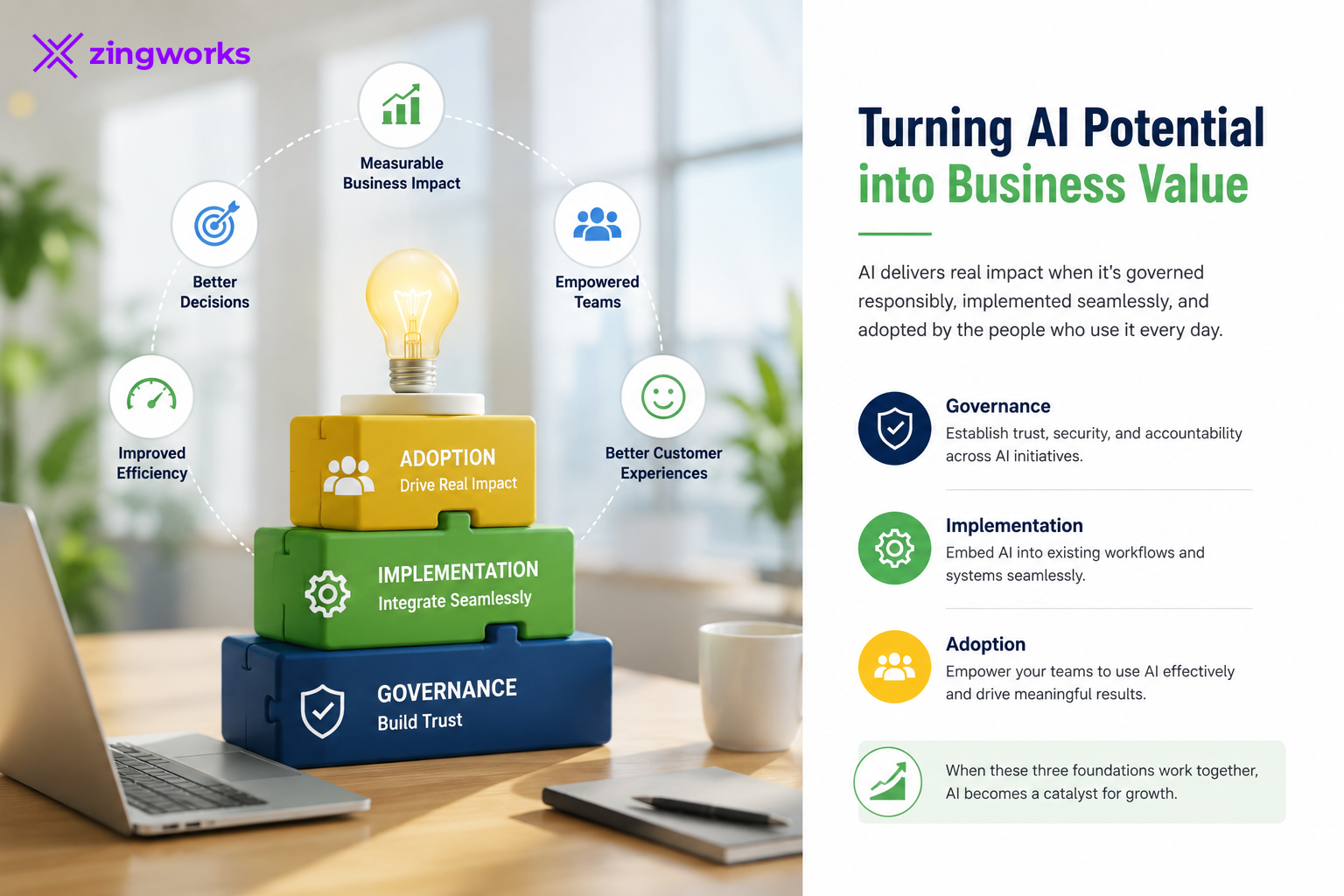
A successful AI strategy depends on three foundations: Governance, Implementation and Adoption.
Start With Business Decisions, Not AI Capabilities
One of the most common mistakes companies make is starting with the question:
“Where can we use AI?”
A better question is:
“Which decisions, processes, or workflows can AI improve?”
The strongest AI initiatives usually begin with specific business outcomes:
- Reducing repetitive work
- Improving response times
- Helping employees find information faster
- Enabling better customer interactions
- Supporting faster and more informed decisions
AI success should not be measured by how quickly a solution is deployed. It should be measured by whether it changes how teams work.
AI Governance: Creating Trust Before Scaling
As AI becomes more advanced, especially agentic AI solutions that can analyze information and support actions, governance becomes essential.
Governance is not about limiting AI innovation. It creates the structure needed to scale AI responsibly.
Enterprise leaders should consider:
- Data access: Does AI provide the right information to the right people?
- Transparency: Can users understand why AI provides certain recommendations?
- Human oversight: Where should human review remain part of the process?
- Accountability: Who owns AI decisions and outcomes?
Organizations that build trust early will have an advantage when expanding AI across departments.
Implementation: Bringing AI Into Existing Workflows
The most effective AI solutions work within existing workflows and support the way teams are already working. Rather than asking teams to change their entire workflow, businesses can bring AI capabilities into existing environments.
A sales representative working in Slack, for example, can quickly access customer-related insights, find relevant information and collaborate with teammates without switching between multiple systems.
Solutions like InsightBot are designed around this approach, helping teams access relevant business information and AI-powered assistance within the systems they already use, including platforms like Salesforce, Acumatica and Slack.
The future of enterprise AI is not about replacing existing platforms. It is about making them more intelligent, connected and valuable.
Adoption: The Difference Between AI Installed and AI Used
A company can successfully deploy AI and still fail to create impact.
The reason is simple: adoption depends on people.
Employees need to know:
- When AI can help them
- How to use it effectively
- When human expertise should guide decisions
The organizations seeing the strongest AI results are not always those with the most advanced technology. They are the ones that make AI practical for everyday users.
A useful way to evaluate AI readiness is to ask:
1. Is this solving a real business challenge?
AI should improve a process, not just demonstrate what technology can do.
2. Does it fit into existing workflows?
Teams are more likely to use AI when it fits naturally into their workflow.
3. Can we measure the impact?
Successful AI projects are built around business goals, not just technology.
Building AI as a Long-Term Business Capability
AI is not a one-time implementation. It is an ongoing process of improving how organizations operate.
The companies that create lasting AI value will be those that combine responsible governance, practical implementation and strong user adoption.
The future will not belong to organizations that simply deploy AI faster. It will belong to those that integrate AI thoughtfully into the way their teams work.
Ready to move beyond AI experiments and identify where AI can create measurable business value? Let’s explore how InsightBot (Deep Analytics Tool) can help your teams bring AI into everyday workflows. Let’s talk.
